
The Operational Architecture of an Election War Room in India
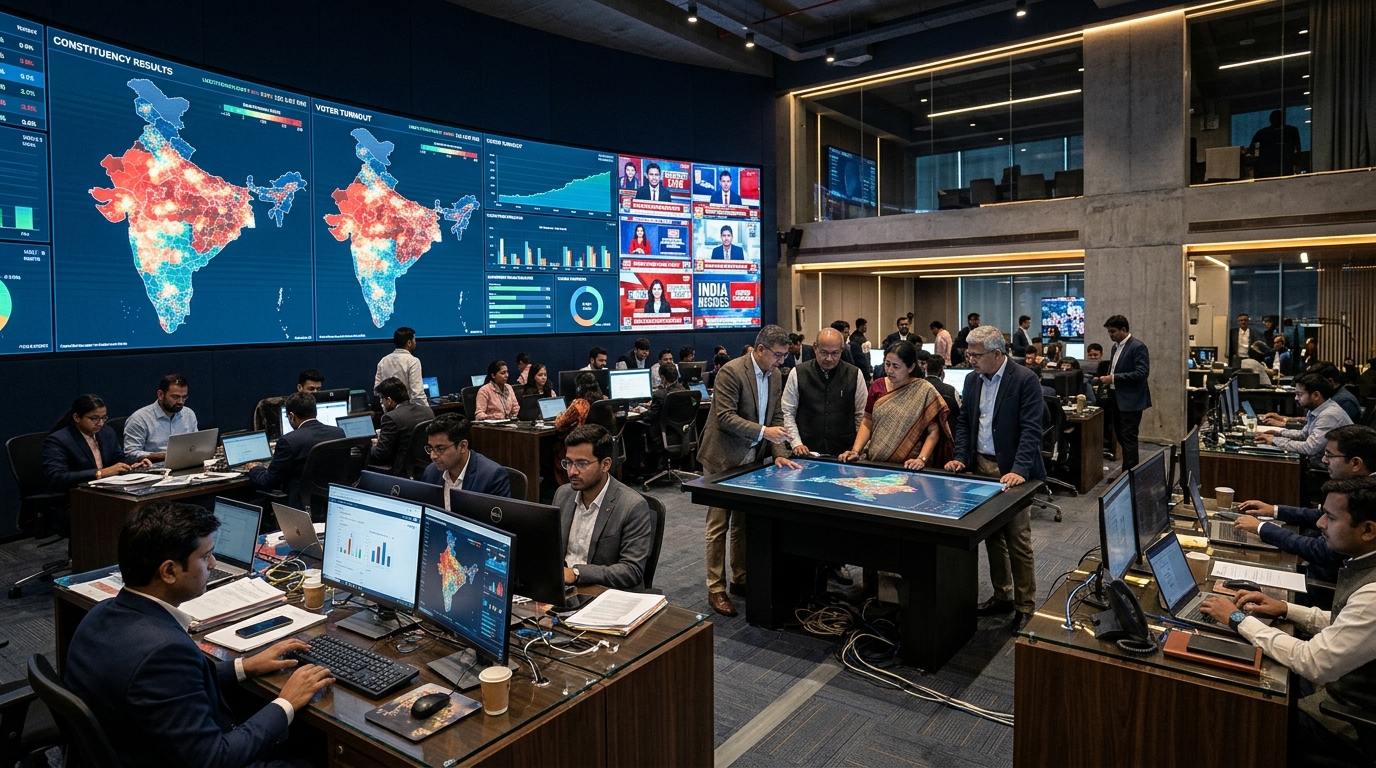
An election war room in India is the centralized nerve center for intelligence, narrative control, and polling-day mobilization. To operate effectively across 250 to 300 polling booths, an assembly campaign requires a 3-tier staffing model (Morning, Swing, Overnight shifts), dual redundant 100 Mbps fiber links with 4G LTE failover, strict physical compartmentalization into public and strategy zones, and a 15-minute verification SLA for counter-narratives.
1. Physical Environment, Network Topology, and Hardware Redundancy
A campaign war room cannot operate from an ad-hoc hotel suite or open party office. It demands strict physical compartmentalization between public-facing campaign workers and the core strategic nerve center.
Network failure during peak polling hours or breaking media controversies can paralyze a campaign. An enterprise-grade war room implements a Dual-WAN Active-Passive architecture with automatic failover, uninterruptible power supply (UPS) systems, and air-gapped database backups.
2. Shift Structuring and Operational Hierarchy
Modern political communication operates 24 hours a day. Rumors, viral WhatsApp forwards, and local television debates do not pause after midnight. An assembly-level campaign requires three continuous shifts:
- Morning Shift (06:00 AM - 02:30 PM): Manages daily newspaper tracking, morning constituency news summaries, and ground rally logistics.
- Swing Shift (02:00 PM - 10:30 PM): The highest velocity shift, executing digital ad deployments, prime-time television tracking, and digital rapid response.
- Overnight Shift (10:00 PM - 06:30 AM): Conducts dark-hour social media listening, WhatsApp group monitoring, and data cleaning for the morning briefing.
Shift continuity is enforced through a standardized Shift Handover Log. The outgoing shift lead must document ongoing digital counter-narratives, unverified ground rumors, and pending legal filings before transferring operational control.
3. The 15-Minute Counter-Narrative Protocol & Verification SLAs
When an opposing campaign releases an out-of-context video clip or false allegation, the war room must respond within fifteen minutes to prevent the claim from cementing in voter perception:
- Minutes 0-3 (Detection & Triage): AI media tracking flags anomalous sentiment spikes. War room lead assigns priority level.
- Minutes 4-8 (Verification & Truth Retrieval): Fact-checking desk validates claims against legal records, official assembly transcripts, or uncut rally footage.
- Minutes 9-12 (Creative Asset Production): Rapid response editors render 15-second contrast video reels and debunking infographics with Section 127A publisher imprints.
- Minutes 13-15 (Omnichannel Distribution): Digital dispatch pushes assets across WhatsApp community broadcast lists, official social handles, and accredited journalist groups.
4. Polling-Day Protocol: Hourly Mobilization Cadence
On polling day, the war room transitions entirely to turnout operations. The operational rhythm follows a strict chronological sequence from 05:30 AM mock polls to 06:00 PM Form 17C reconciliation.
By comparing real-time hourly voter turnout against historical baseline voter models, the data analytics desk identifies lagging bellwether polling booths and immediately dispatches mobile Panna Pramukh ground volunteers to execute targeted voter mobilization.
Frequently Asked Questions
What is an election war room in Indian politics?
An election war room is a centralized, high-security operational center where data analysts, campaign strategists, legal experts, and media monitors coordinate real-time narrative defense, digital voter outreach, and ground polling-day mobilization.
How many staff members are required for an Assembly constituency war room?
A typical Vidhan Sabha constituency war room (covering 250 to 300 polling booths) requires 18 to 25 core personnel distributed across 3 continuous shifts, including an operations director, data analysts, media trackers, video editors, and legal compliance officers.
What are the key IT redundancy requirements for a war room?
Essential IT requirements include dual redundant enterprise broadband connections (with automated 4G/5G failover), true online sine-wave UPS backups, isolated VLAN networks separating media from voter databases, and encrypted air-gapped storage.
Authored by Jagmohan Kurmi
AI-driven full-stack digital marketing expert and political campaign strategist. Specializing in high-tech war room architectures, voter intelligence databases, and ECI compliance frameworks for state assembly and parliamentary elections across Madhya Pradesh and Central India.