
Network Latency Optimization in Rural & Deep-Village Belts: Building Resilient Offline-First Mobile Sync for Assembly Campaigns
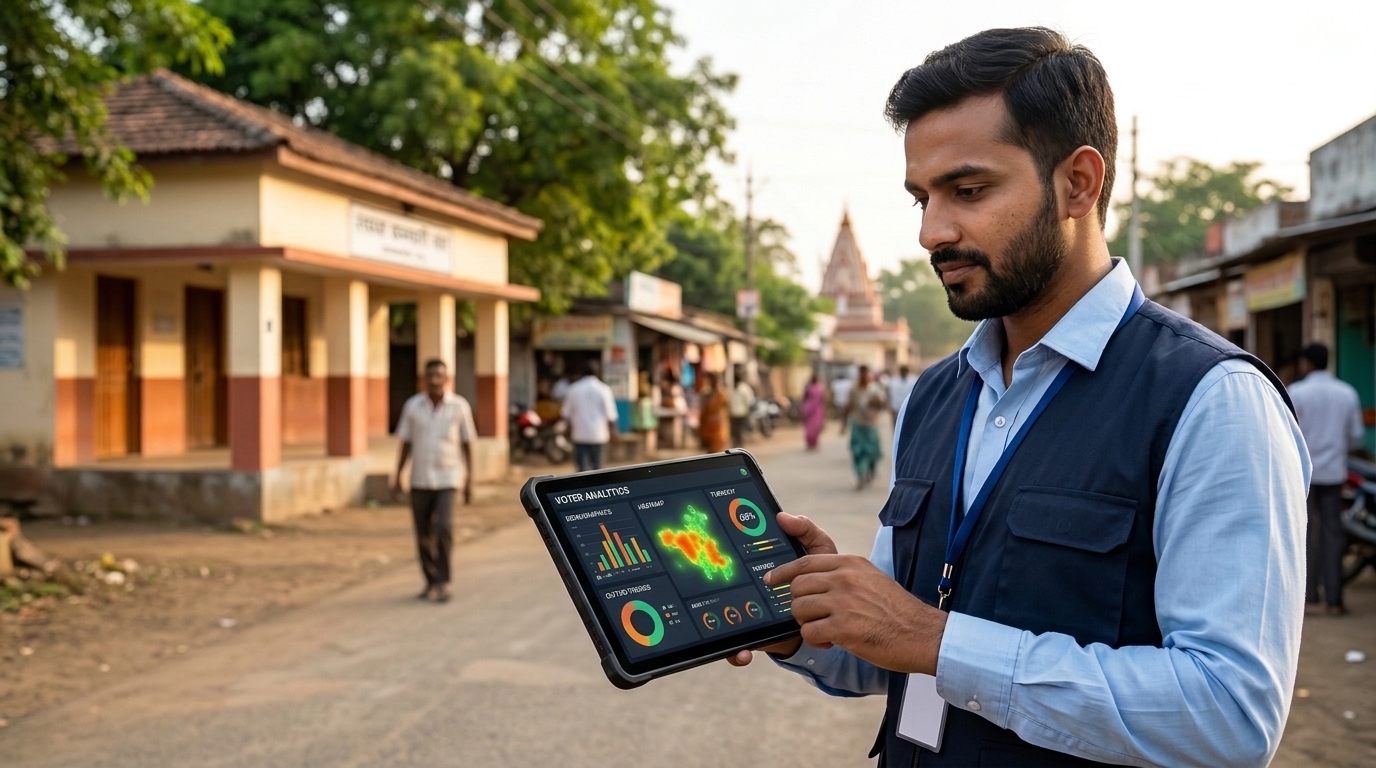
In rural and forest assembly constituencies across Central India where 35% to 60% of polling stations face severe cellular connectivity shadows, political campaigns deploy Offline-First Android mobile architectures. By combining local encrypted SQLite/Room databases (pre-seeding 1,200 booth electors), binary Protocol Buffers (slashing sync payloads by 95% over 2G/EDGE), and Last-Write-Wins with State Precedence conflict resolution (LWW-CRDT), booth agents maintain continuous voter lookup and turnout tracking without cell reception.
1. The Offline-First Paradigm: Local-as-Single-Source-of-Truth
When an assembly constituency spans 250 to 300 polling booths across remote rural hamlets in Bundelkhand, Mahakoshal, or the Chambal ravines, up to 60% of booths experience chronic network dropouts and 2G mobile shadows. Cloud-dependent web wrappers and REST APIs fail catastrophically.
In high-performance political field engineering, the architecture is inverted: the local SQLite database on the volunteer's smartphone is the single source of truth:
2. Bandwidth Optimization: Replacing JSON with Protocol Buffers (Protobuf)
Standard REST JSON payloads contain heavy metadata overhead that causes transmission timeouts on 2G networks with 800ms latency. Replacing JSON with compiled binary Protocol Buffers (Protobuf) combined with Gzip compression reduces payload sizes by over 95%:
This allows field devices to transmit 50 voter updates during a momentary 2-second cellular signal burst without freezing the user interface.
3. Conflict Resolution & Budget Hardware Optimization
When multiple booth volunteers (table agent, runner, mobilizer) update records offline and reconnect simultaneously, the sync engine applies deterministic **State Precedence Hierarchy**:
- Level 100 ("VOTED"): Terminal state. Cannot be overwritten by "Mobilized" or "Untouched".
- Level 80 ("DECEASED / SHIFTED"): Overwrites Mobilized/Untouched; overridden only by Voted.
- Level 50 ("MOBILIZED"): Governed by Last-Write-Wins (LWW) monotonic UTC timestamps.
Furthermore, to support ₹7,000 budget Android smartphones (2GB RAM, 40°C thermal throttling), apps enforce strict memory limits: sub-12MB APK size, SVG vector drawables, zero background GPS tracking, and batched SQLite disk writes.
Frequently Asked Questions
Why do cloud-based mobile apps fail in rural Indian elections?
In rural assembly constituencies, between 35% and 60% of polling stations face erratic 2G coverage, network dead zones, and tower power cuts. Cloud-dependent apps freeze on infinite loading spinners, preventing booth agents from searching voter slips or reporting hourly turnout.
How does offline-first sync prevent duplicate voter records?
By pre-seeding the local SQLite database with unique EPIC voter ID keys and implementing Last-Write-Wins with State Precedence (LWW-CRDT), the central sync engine deterministically resolves concurrent updates without data corruption.
Can field workers sync voter data without any cellular internet at all?
Yes. Field applications can utilize local Wi-Fi Direct and Bluetooth Low Energy (BLE) peer-to-peer mesh networks between booth workers, or deploy mobile runners acting as 'data mules' who carry encrypted sync batches on motorcycles back to cellular coverage zones.
Authored by Jagmohan Kurmi
AI-driven full-stack digital marketing expert and election campaign strategist. Specializing in high-tech war room architectures, voter intelligence databases, and ECI compliance frameworks for state assembly and parliamentary elections across Madhya Pradesh and Central India.