How AI Search Decides Which Businesses to Recommend
When ChatGPT names three businesses and leaves out the rest, it looks like a verdict. It is not a verdict, it is a synthesis, and understanding how that synthesis works is more useful than resenting it. Nobody outside OpenAI, Google, or Anthropic knows the exact weighting inside these models, and anyone claiming a proprietary formula is guessing. What is observable is the pipeline and the factors that consistently show up when you study which businesses get named. This guide explains those factors honestly.
Quick Answer: How Does AI Search Decide Which Businesses to Recommend?
AI search engines retrieve candidate content for a question, score it for relevance and clarity, and generate an answer from the sources they can most confidently summarize and attribute. Businesses get recommended when they are clearly described, consistently represented across the web, corroborated by independent sources, and directly relevant to the question. Nobody can force a recommendation, because the final selection is internal to the model.
The Pipeline: Retrieve, Score, Generate
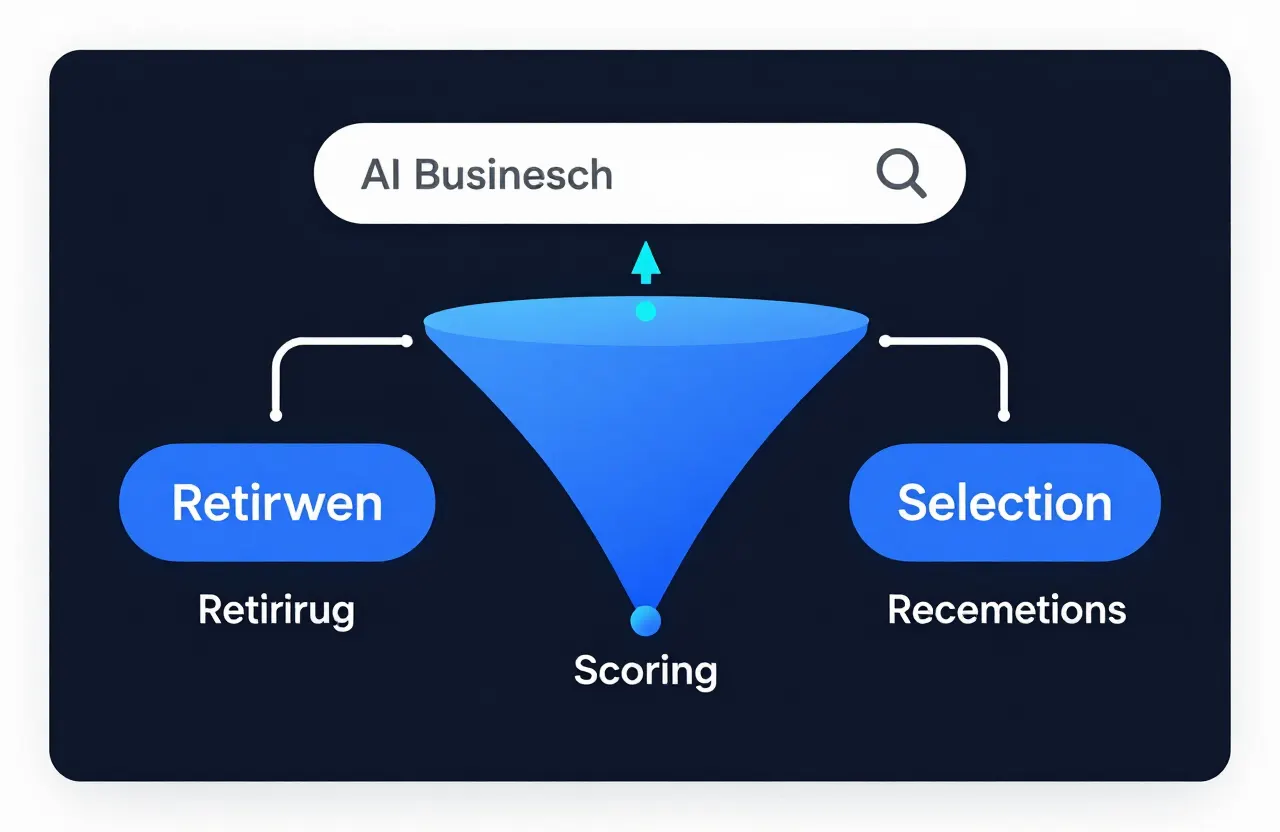
Most AI search answers follow the same three stages, and each stage filters businesses out before the next one ever sees them.
- Retrieve: The engine finds candidate pages for the question. If your content is not crawlable, not relevant, or not present where the engine looks, you are filtered out here, before quality matters at all.
- Score: Candidate passages are weighed for relevance, clarity, and authority. Content that states a clean answer near the top, on an entity the engine can resolve, scores better than scattered or vague content.
- Generate: The model synthesizes an answer from the passages it can most confidently summarize, and names the sources behind them. Confidence, not size, decides who gets named.
This is why a small business with a crisp, consistent footprint often beats a larger one whose identity is scattered. The model is not rewarding budget, it is avoiding the risk of getting a fuzzy entity wrong. For the mechanics of citation specifically, see how to get cited in AI search.
Factor 1: Can the Model Describe You Without Getting It Wrong?
The strongest single predictor of who gets named is whether the model holds a clean picture of the business. That picture comes from your website, your Google Business Profile, directories, reviews, and mentions, all agreeing on the same facts. When they agree, the model describes you confidently. When they disagree, it hedges, and hedging usually means naming someone else. This is the entity layer, covered in how AI search understands brands and entity SEO explained.
Factor 2: Is There a Clean Answer to Lift?
At the scoring stage, the engine is looking for passages it can quote or summarize without distortion. A page that answers the question in the first 40 to 60 words, in a self-contained sentence, is easy to lift. A page where the answer is buried under an introduction, or scattered across paragraphs, gives the model nothing clean to use, so it uses someone who did. Structure is not decoration here, it is the difference between being quotable and being paraphrased into invisibility. See the answer engine optimization guide.
Factor 3: Do Independent Sources Agree?
A model generating an answer is taking a public risk, and it favours claims that several independent sources corroborate. Your own site is one voice. Directories, genuine reviews, industry mentions, and a complete Google Business Profile are the corroboration that makes naming you low-risk. This is why businesses with a handful of accurate, consistent mentions often outperform businesses with a beautiful site and nothing around it. The honest caveat: corroboration must be genuine, fabricated reviews and bought mentions corrode trust when detected.
Factor 4: Is Your Content Relevant to the Actual Question?
Relevance sounds obvious, but it is where most businesses quietly fail. The engine matches the question's intent to content, not to your self-image. If a customer asks "who fixes leaking roofs in Jabalpur" and your site says "comprehensive building envelope solutions," there is no match to make. Relevance is about vocabulary alignment, using the words customers use, and coverage, having a page that genuinely addresses the question. How engines evaluate this is covered in how AI search evaluates content relevance.
Factor 5: Recency and Freshness
Answers about services, prices, and availability go stale. Engines favour content whose facts look current, and a page whose copyright says three years ago, or whose prices are visibly outdated, is a riskier source to quote. Freshness is not about publishing daily, it is about your key facts not looking abandoned. The maintenance side of this is covered in the AI search content refresh audit.
What Nobody Can Promise You
Every factor above is real and workable, and none of them is a lever that forces a recommendation. The final selection happens inside a model whose internals are not published, answers vary by user, location, and session, and a competitor with a genuinely stronger footprint may keep the slot. Anyone selling a guaranteed method to make ChatGPT name your business is selling certainty that does not exist. What you can do is make every factor above as strong as honestly possible, and measure whether your presence grows over months.
How to Read Your Own Situation
Before working on any factor, find out which one is failing you. Ask the engines your target questions, note whether you are absent, named vaguely, or cited, and compare how competitors are described. That diagnostic, rather than generic effort, tells you whether your gap is entity, structure, corroboration, or relevance. The method is in how to check your AI search visibility.
Conclusion
AI search decides who to recommend through a pipeline that filters for access, clarity, entity confidence, corroboration, and relevance, then generates an answer from the sources it can most safely summarize. You cannot control the final choice, but every factor feeding it is improvable, and businesses that improve them systematically do get named more over time. Start by finding out which factor is your weakest.
If you want a professional read on which factor is holding your business back, our AI visibility audit tests exactly this, and GEO services and AI SEO services work on the factors themselves. Or book a free consultation. Related reading: why ChatGPT recommends your competitors.
Ready to Implement This Strategy?
Stop reading and start executing. Explore our Data-Driven SEO Services or book a direct strategy call.
Book Your Strategy AuditFrequently Asked Questions
Transform Insights into Revenue
Partner with an AI-driven consultant to map out a measurable growth system specifically for your brand.

Jagmohan Kurmi
AI-Driven Full-Stack Digital Marketer
Jagmohan Kurmi helps Indian businesses grow with SEO, local SEO, Google Ads, Meta Ads, WordPress websites, AI visibility, lead generation, content strategy, AI tools training, and performance-focused digital marketing systems. As an AI SEO Expert in India, I specialize in Answer Engine Optimization and data-driven performance marketing using my M.Tech in Industrial Engineering and Management framework.