How to Build an AI-Ready Content Workflow
Most businesses do not have an AI search problem. They have a content workflow problem. Pages get written in a rush, published without structure, and never refreshed, so even good advice never gets cited by AI engines. An AI-ready content workflow fixes this by turning content production into a repeatable process where every page is researched, structured, reviewed, published, and refreshed with clarity in mind. This guide walks through that workflow end to end.
Quick Answer: What Is an AI-Ready Content Workflow?
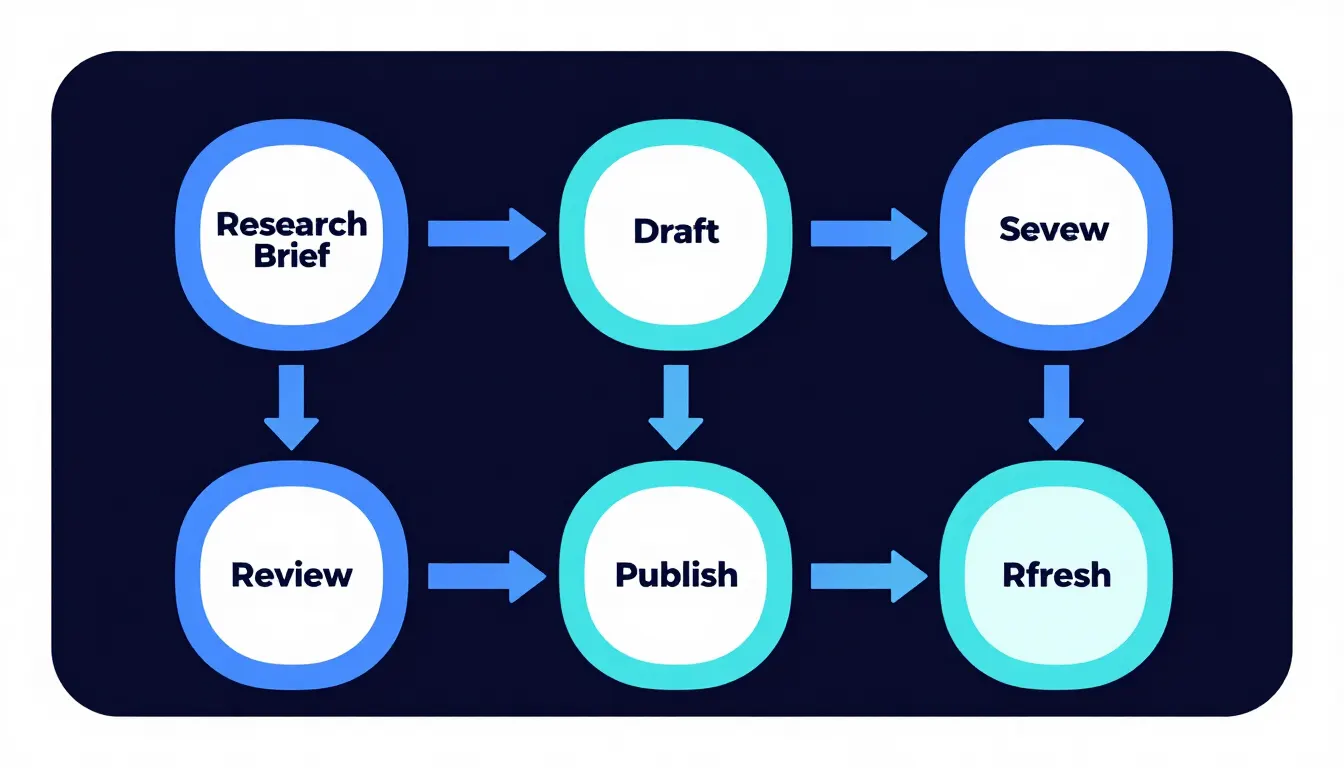
An AI-ready content workflow is a repeatable production process with five stages: research and brief, draft with answer-first structure, review for clarity and evidence, publish with schema and metadata, and refresh on a schedule. Each stage has a small checklist so any writer can consistently produce pages that are clear, well-structured, and easy for AI engines to understand and cite. The goal is consistency, not heroics.
Why a Workflow Beats One-Off Effort
A single brilliantly written page rarely earns AI citations on its own. AI engines look for topical depth and consistency, which comes from a body of well-structured work. A workflow ensures every page meets the same clarity standard, builds topical authority over time, and stays fresh. One-off effort produces islands; a workflow produces a connected, citable library.
Stage 1: Research and Brief
Before writing, define what the page must accomplish. A good brief captures:
- The one question this page answers, phrased as a customer would ask it.
- The primary and related semantic keywords.
- The target audience and their current knowledge level.
- The existing pages it should link to and from.
- The evidence or sources you will cite.
A brief forces you to decide intent before drafting, which prevents rambling, off-topic pages. For a detailed template, see how to build a search-ready content brief.
Stage 2: Draft With Answer-First Structure
Write for extraction. AI engines pull the first clear answer they find, so structure matters from the first sentence.
- Lead with a direct answer: A 40 to 60 word self-contained answer right after the H1.
- Use question-style H2s: They match how people and engines parse content.
- Use lists and tables: Models extract structured data more reliably than prose.
- Keep paragraphs short: Two to four sentences, one idea each.
- Add original examples: Specifics beat generics. See how to use original examples in AI search content.
For the writing principles behind this, read the answer engine optimization guide.
Stage 3: Review for Clarity and Evidence
Before publishing, run the draft through a review checklist. This is where most workflows fail because there is no review step.
- Does the first paragraph answer the title question directly?
- Is every factual claim backed by a cited primary source?
- Are headings logical and question-style where useful?
- Is the author attributed with a real bio?
- Are there original examples, not generic filler?
- Is the language clear and free of unnecessary jargon?
For how to evidence claims properly, see how to show evidence in AI search content. A second pair of eyes at this stage catches assumptions the writer missed.
Stage 4: Publish With Schema and Metadata
Publishing is not just hitting the button. Make the page machine-readable:
- Add Article schema with author and date attribution.
- Add FAQ schema if the page has visible FAQs.
- Add Breadcrumb schema for navigation context.
- Set a unique SEO title and meta description.
- Set canonical and OpenGraph tags.
- Use descriptive alt text on every image.
For the structured data layer, read schema markup for AI search. Validate with the Rich Results Test before considering the page done.
Stage 5: Refresh on a Schedule
AI engines favor current content. A page published once and forgotten slowly loses relevance. Build refresh into the workflow:
- Review top pages quarterly for accuracy and broken links.
- Update statistics and references to current sources.
- Show a visible updated date and reflect it in schema.
- Add new internal links as your cluster grows.
- Re-test AI visibility after major refreshes.
For the refresh process, see the AI search content refresh audit.
The Full Workflow at a Glance
| Stage | Key Output | AI-Ready Check |
|---|---|---|
| Research and brief | One question, keywords, sources | Intent is clear before writing |
| Draft | Answer-first structured content | First paragraph answers the question |
| Review | Checked, evidenced draft | Every claim cited, examples original |
| Publish | Live page with schema | Schema validates, metadata set |
| Refresh | Updated, current page | Updated date visible and accurate |
Common Workflow Mistakes
- Skip the brief: Writing without intent produces off-topic, un-citable pages.
- No review step: Publishing first drafts ships assumptions and errors.
- Forget schema: Great content without structured data is harder to extract.
- Publish and forget: Stale content loses relevance and trust signals.
- No internal linking plan: Isolated pages miss the topical authority benefit.
- Inconsistent process: Different writers, different standards, no compounding quality.
Best Practices
- Use the same checklist for every page so quality is consistent.
- Keep briefs short, one page, so writers actually use them.
- Have a second reviewer for evidence and clarity, not just grammar.
- Validate schema before publishing, not after.
- Schedule refreshes in a calendar so they actually happen.
- Document the workflow so new team members ramp fast.
Limitations to Be Honest About
A great workflow improves your odds of being understood and cited, but it does not guarantee citations. AI engines are non-deterministic, and competitors may publish similar content. The workflow is a quality and consistency discipline, not a ranking guarantee. Also, a workflow only helps if you actually follow it; a documented process ignored is the same as no process. For team-level coordination, see AI search content governance for marketing teams.
Conclusion
An AI-ready content workflow turns content production from a series of one-off efforts into a repeatable process. Research and brief, draft with answer-first structure, review for clarity and evidence, publish with schema and metadata, and refresh on a schedule. Each stage has a small checklist, and together they consistently produce pages that are clear, well-structured, and easy for AI engines to understand and cite. The payoff is not a single viral page but a connected, authoritative library that compounds over time.
If you want help designing an AI-ready content workflow for your team, explore our AI SEO services or book a free SEO consultation. For related reading, see how to build AI search visibility and the AI search readiness checklist for 2026.
Ready to Implement This Strategy?
Stop reading and start executing. Explore our Data-Driven SEO Services or book a direct strategy call.
Book Your Strategy AuditFrequently Asked Questions
Transform Insights into Revenue
Partner with an AI-driven consultant to map out a measurable growth system specifically for your brand.

Jagmohan Kurmi
AI-Driven Full-Stack Digital Marketer
Jagmohan Kurmi helps Indian businesses grow with SEO, local SEO, Google Ads, Meta Ads, WordPress websites, AI visibility, lead generation, content strategy, AI tools training, and performance-focused digital marketing systems. As an AI SEO Expert in India, I specialize in Answer Engine Optimization and data-driven performance marketing using my M.Tech in Industrial Engineering and Management framework.