How to Build Content AI Search Engines Can Understand
There is a gap between content a human can read and content an AI engine can understand. A beautifully written essay with flowing paragraphs can be nearly useless to a retrieval system trying to extract an answer, while a plainer page with clean structure gets lifted into generated answers regularly. The difference is not writing talent. It is whether the page states its entities, defines its terms, answers its question directly, and organizes facts so a machine can parse them without guessing. This guide is the page-level playbook for that.
Quick Answer: How Do You Build Content AI Search Engines Can Understand?
Make each page answer one clear question in the first paragraph, define every entity and technical term the first time it appears, structure facts in headings, lists, and tables rather than burying them in prose, keep terminology consistent across the page and the site, state facts accurately with sources, and keep the page crawlable and fast. Understanding is a parsing problem first and a quality problem second; fix both.
Table of Contents
- What understanding means for an AI engine
- The five layers of understandable content
- Structure: the parsing layer
- Answers: the extraction layer
- Entities and terminology: the meaning layer
- Accuracy and crawlability: the trust and access layers
- A page-level framework you can apply today
- Common mistakes
- FAQs
What Understanding Means for an AI Engine
When a generative engine reads your page, it is trying to do three things: identify what the page is about, extract the claims it makes, and decide whether those claims can be trusted enough to synthesize into an answer. A page understands well when all three are easy. That means the topic is unmistakable, the claims are stated rather than implied, and the facts are verifiable. Pages fail understanding not because they are badly written but because their meaning is scattered, implicit, or ambiguous. How engines judge relevance once they have parsed you is covered in how AI search evaluates content relevance.
The Five Layers of Understandable Content
| Layer | What It Answers | Core Practice |
|---|---|---|
| Structure | Can the page be parsed? | Headings, lists, tables, short paragraphs |
| Answers | Can the answer be extracted? | Direct answer in the first paragraph |
| Entities and terms | What is this about, precisely? | Define entities and terminology on first use |
| Accuracy | Can the claims be trusted? | Factual statements with sources |
| Crawlability | Can the page be reached and read? | Indexable HTML, fast pages, clean sitemap |
Most content teams work on one layer, usually structure, and wonder why AI engines still misread them. The layers compound: a perfectly structured page with ambiguous entities still confuses a model, and a precise page that cannot be crawled never gets read at all.
Structure: The Parsing Layer
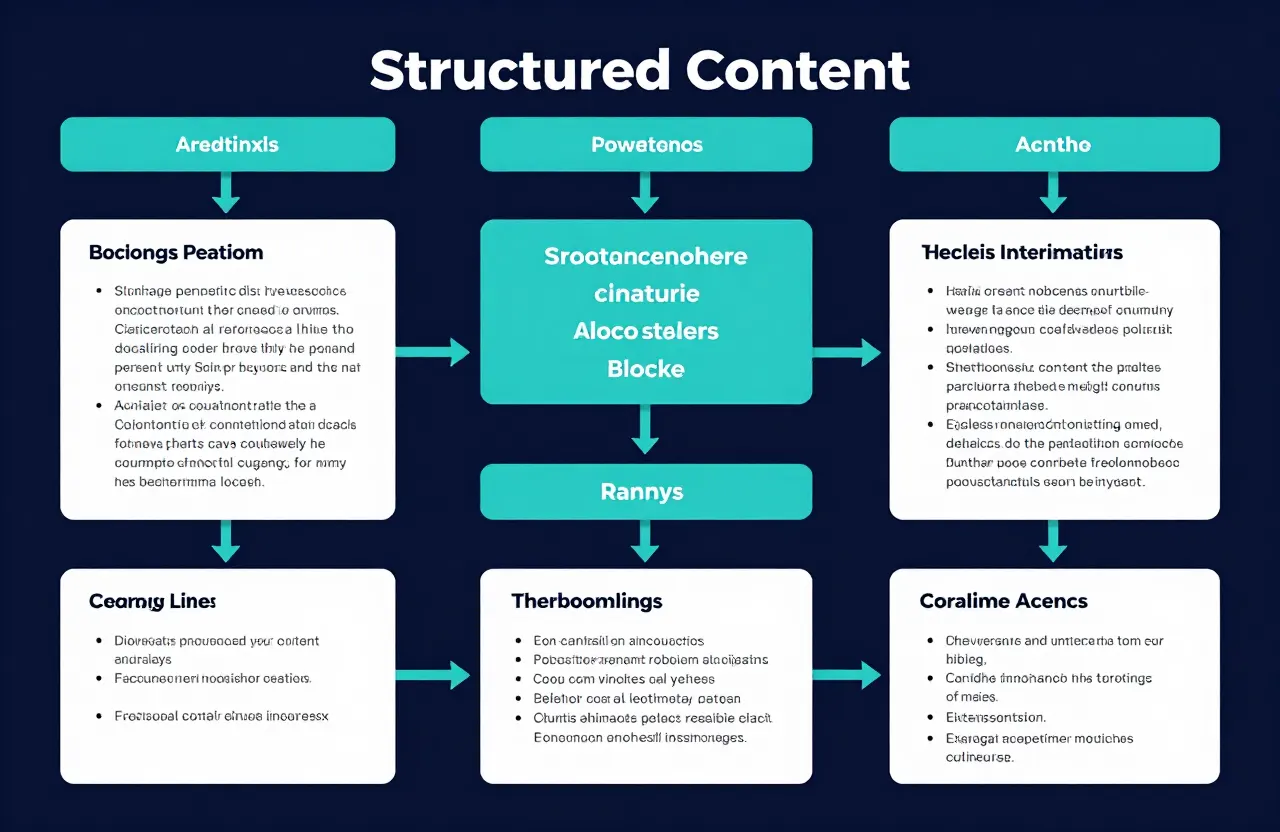
Structure is what lets a machine segment your page into meaningful units. Use one H1 that states the topic, H2s phrased as the questions readers actually ask, and short paragraphs that each carry one idea. Put comparable facts into lists and data into tables, because structured facts are extracted with far less distortion than facts woven into prose. If a paragraph exists purely to transition, cut it; transitions are for human flow, and they are where extraction goes wrong. For how this applies to a specific page type, see how to create an AI-readable service page. For the dedicated treatment of structural patterns, headings, and extractable answers, read how to structure content for AI search and AEO.
Answers: The Extraction Layer
Every page should answer its core question in the first 40 to 60 words, in a self-contained sentence that survives being pulled out of context. Write that sentence as if it will be quoted alone, because sometimes it will be. Then expand with the detail, nuance, and examples that serve human readers and traditional rankings. The short answer earns the extraction; the depth earns the trust. This answer-first pattern is the core of answer engine optimization, and it works for definitions too, as covered in optimizing definitions for answer engines.
Entities and Terminology: The Meaning Layer
This is the layer most content misses. An engine reading your page is identifying entities, people, companies, places, tools, concepts, and connecting them to what it already knows. You help it by being explicit:
- Name entities fully on first use. Google Search Console first, GSC after, never the reverse.
- Define technical terms where they appear. A one-sentence definition next to the term beats a glossary page nobody reaches.
- Keep terminology consistent. If the page calls it AI Overviews in paragraph one, it should not call it AI summaries in paragraph five without reason. Synonym variation that reads as richness to humans reads as ambiguity to a model.
- State relationships explicitly. Saying that X is a feature of Y that does Z beats implying the relationship through context.
- Give context for examples. An example labeled as an example, with its situation stated, is understood; an unlabeled one may be absorbed as a general claim.
Original examples are one of the strongest understanding signals you can add, because they demonstrate the concept in context. The method is in how to use original examples in AI search content.
Accuracy and Crawlability: The Trust and Access Layers
Accuracy is a comprehension issue, not just an ethics issue. When your page states facts that conflict with what the engine can verify elsewhere, it lowers confidence in the whole page, and hedged or wrong content gets skipped. State facts plainly, cite sources for claims a reader would question, and label interpretation as interpretation. The full approach is in how to show evidence in AI search content.
Crawlability is the gate before everything else. Content locked behind unreadable JavaScript, blocked by robots rules, or sitting on slow pages may never be read at all. The technical checklist is in how to make your website ready for AI search. No amount of writing quality compensates for a page the engine cannot fetch.
A Page-Level Framework You Can Apply Today
Take any important page and run it through these seven checks:
- Does the first paragraph directly answer the question the page exists for?
- Is there exactly one H1, and does it state the topic plainly?
- Are headings phrased as real questions or clear topics, not clever labels?
- Is every technical term defined at first use, and is terminology consistent throughout?
- Are facts that a reader would question backed by a source link?
- Are lists and tables used for anything comparable or countable?
- Is the page crawlable, fast, and free of accidental noindex rules?
Fix the failures in that order. The first three fix extraction, the middle two fix meaning, the last two fix access and trust. For turning this into a repeatable process across a whole site, see how to build an AI-ready content workflow.
Common Mistakes
- Writing for flow and burying the answer three paragraphs deep.
- Using abbreviations before the full term ever appears.
- Varying terminology for stylistic richness, which reads as ambiguity to models.
- Leaving examples unlabeled, so illustrations risk being absorbed as claims.
- Assuming a beautiful page is a parseable page; the two are unrelated.
- Skipping the crawlability check and optimizing content engines cannot fetch.
Conclusion
Building content AI engines can understand is a layered discipline: structure that parses, answers that extract, entities and terminology that carry meaning, facts that hold up, and pages that can actually be reached. None of the layers is optional, and they compound. Run the seven-check framework on your most important pages, fix failures in order, and you will find that the same changes that make your content easier for machines to understand also make it easier for humans to use, which is the quiet point of all of this.
If you want this applied to your site, our AI search optimization services and AEO services cover content restructuring end to end, or start with an AI SEO audit. Related reading: how AI search evaluates content relevance and how to create an AI-readable service page.
Ready to Implement This Strategy?
Stop reading and start executing. Explore our Data-Driven SEO Services or book a direct strategy call.
Book Your Strategy AuditFrequently Asked Questions
Transform Insights into Revenue
Partner with an AI-driven consultant to map out a measurable growth system specifically for your brand.

Jagmohan Kurmi
AI-Driven Full-Stack Digital Marketer
Jagmohan Kurmi helps Indian businesses grow with SEO, local SEO, Google Ads, Meta Ads, WordPress websites, AI visibility, lead generation, content strategy, AI tools training, and performance-focused digital marketing systems. As an AI SEO Expert in India, I specialize in Answer Engine Optimization and data-driven performance marketing using my M.Tech in Industrial Engineering and Management framework.